A Guide to Caravan and Camper Trailer Shocks
Camper trailers, caravans and tow vehicles come in all shapes and sizes, even though they’re often tackling the same terrain. Thankfully, custom-designed caravan shock absorbers can help different suspensions meet these challenges successfully.
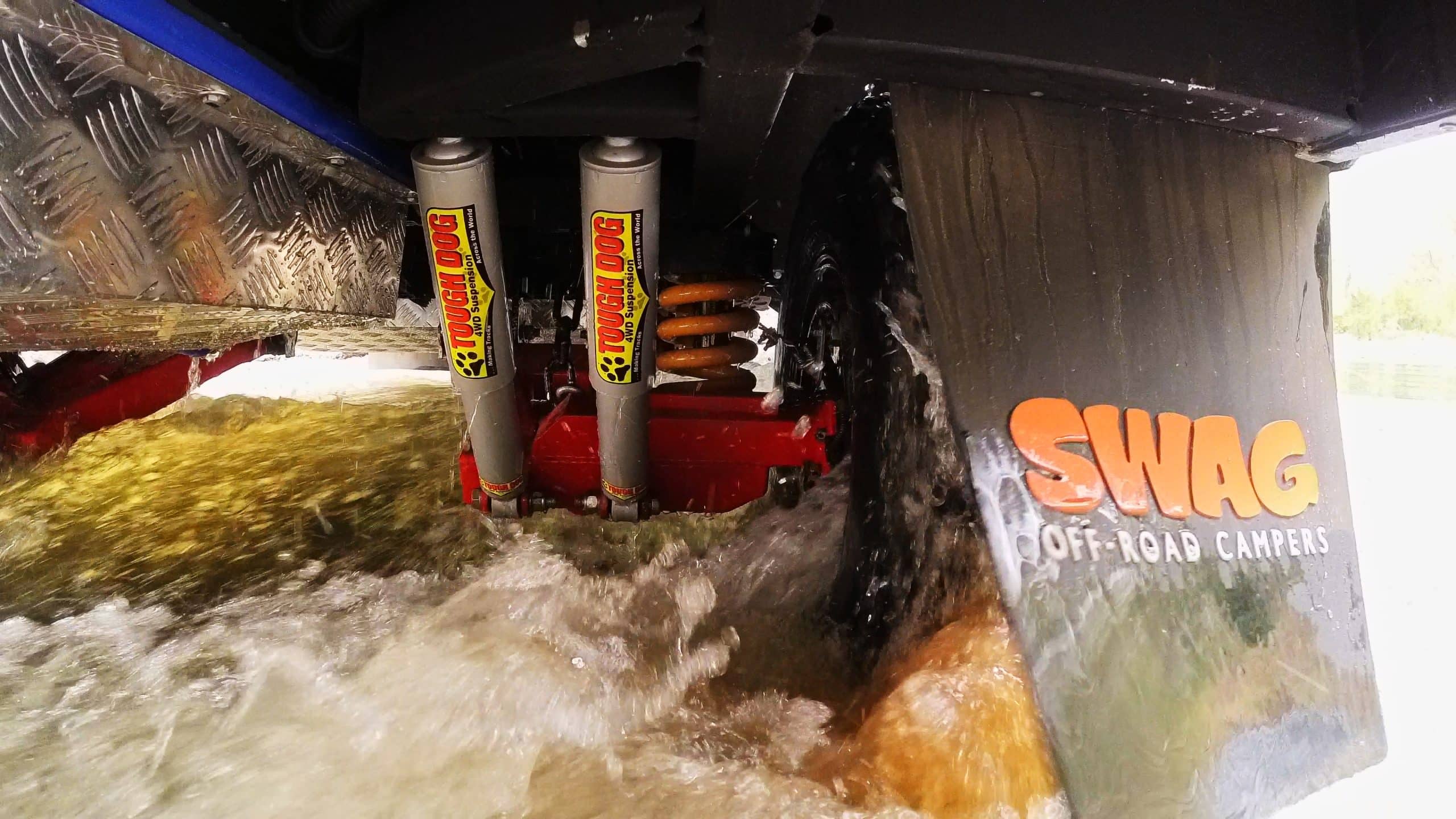
Here’s how shock absorbers work, how shock manufacturers improve performance in difficult conditions and how Tough Dog designs shock absorbers for different caravan and camper trailer suspension systems—like on the Swag SCT Hybrid Gen8 range.
We chat to Scott Osborne from Tough Dog 4WD Suspension to find out more.
The Role of Shock Absorbers, the Problem of Fade & How to fix it
Shock Absorbers play a vital role in your caravan’s suspension system, controlling the compression and rebound of the springs in your caravan or trailer’s suspension setup says Scott.
“As the suspension travels up and down, the piston in the shock forces the oil through valves in the body, slowing down the movement of the piston, and in turn, your suspension’s spring.”
Problem is, out on the tracks, heat plays havoc with shock absorber performance causing them to fail without vital mitigation strategies.
“As your shock cycles and the oil heats up, it can thin out and develop bubbles – known as aeration. If the oil becomes too aerated, it can’t resist the movement of the spring and this will cause problems with the handling of your vehicle. This is known as shock fade.”
How Nitrogen minimises Shock Absorber Fade
Shock absorber manufacturers handle this in a few ways, “gas-pressurised” shocks, for example, use nitrogen that prevents aeration of the oil when the shock is being worked hard.
How Twin Tube Designs Dissipate Heat
Twin-tube shock absorbers have another neat trick, circulating fluid between inner and outer tubes, increasing volume and surface area to better dissipate heat and prevent the oil from overheating.
“In a twin tube shock, the inner cylinder contains the piston rod, piston valve, and oil, while the outer tube holds the extra oil in reserve. Any space in the outer tube of the shock that is not filled with oil is normally taken up by air or nitrogen gas,” Scott explains.
How Foam Cell technology improves shock performance
“In a twin-tube shock that is equipped with a Foam Cell insert, this ‘empty’ space is instead filled with a micro-cellular foam insert. Because the gas is encapsulated in foam, it eliminates the possibility of the gas mixing with the oil and aerating, allowing the shock to function with an unparalleled resistance to shock fade.”
According to Scott, the foam cell insert [like those found in the Tough Dog Big Bore shocks] is also more compact than the nitrogen gas charge, which means you can fit more oil in, improving the shock’s ability to disperse heat.
“Extra oil and reduced cavitation means that Tough Dog foam cell shocks are proven to take longer to overheat, meaning you’re less likely to experience shock-fade, even on the roughest tracks!”
Why Custom Caravan Shock Absorbers Are Essential for Towing
But anti-fade technology is only half the story, a shock absorber needs to match the suspension system it belongs to if it’s to work optimally. Thankfully, Tough Dog has developed shock absorbers to fit suspensions across more than 20 different camper trailer and caravan platforms.
“Every vehicle we work on, we’re aiming to control the oscillation of the springs, improve the durability of the suspension, and by doing that, enhance the quality of the ride.”
What is Shock Motion Ratio and why does it matter
“Step 1 in the development process is always to establish the shock motion ratio. We measure the wheel travel of the vehicle, and compare that against the shock travel. Once we’ve got those distances, we can then calculate the open and closed lengths of the shock, which determines the maximum travel of the suspension.”
According to Scott, key moments in a suspension’s motion path provide clues to these vital specifications.
“The minimum closed length is shorter than the maximum compression at the bump’s top, and the maximum open length is longer than the limit of the straps/chains at full droop. This ensures the shock is not topping out at full droop, or bottoming out at full compression, to give the maximum longevity of the suspension components.”
Matching Shock Absorbers with Spring Behaviour
Shock absorbers must also account for a spring’s behaviour.
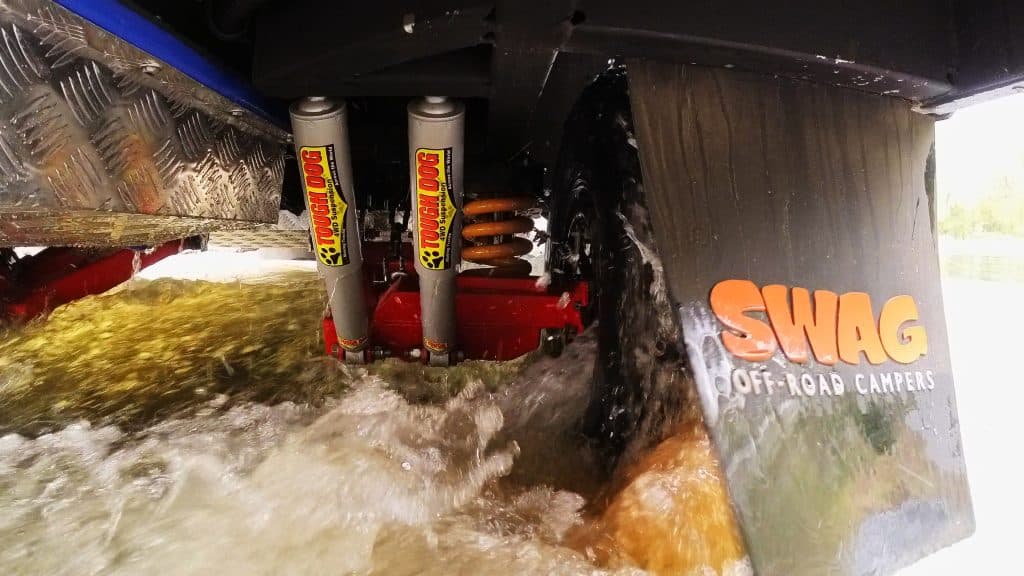
“The valving of the shock (the speed the oil travels through the valves in the shock body) is also matched to the spring rate of the vehicle, to help control the bounce of the spring. We’ve fitted four shocks to the SCT Hybrid Gen8, for improved heat dissipation, and again, to help control the movement of the springs.”
Tough Dog also fits a ‘crush tube’ to the shock bushes to help strengthen the bush and alleviate any side-loading pressures.
“This is just another way we ensure the durability of the shocks,” Scott explains.